- For any information contact us at
- +923004007320
- aquarefiner@gmail.com
Best Water Filter in Pakistan – Complete Buying Guide
Are you looking for the best water filter in Pakistan for your home, office, school, restaurant, or business? Choosing the right water purification system is important because water quality can vary significantly depending on the source, location, and distribution system.
Some households receive municipal water, while others depend on bore wells, tankers, or stored water. Each source may have different treatment requirements. A filter that improves taste may not remove dissolved salts, while a system that reduces TDS may still require additional treatment to ensure microbiological safety.
In this complete buying guide, Aqua Refiner explains the different types of water filters available in Pakistan, their uses, approximate prices, maintenance requirements, and how to choose the right system for your needs.
Why Do You Need a Water Filter in Pakistan?
Water quality is an important consideration for households and businesses throughout Pakistan. Depending on the source, water may contain suspended particles, excessive dissolved minerals, microorganisms, or unwanted chemical contaminants.
Common water quality concerns include:
- Sediment, sand, and rust particles
- Unpleasant taste and odour
- Excessive hardness and mineral deposits
- High concentrations of dissolved salts
- Microbiological contamination
- Specific chemical contaminants, such as arsenic or nitrate, in some sources
Not every water source has all these problems. The correct treatment depends on laboratory testing and the intended use of the water.
The Pakistan Council of Research in Water Resources (PCRWR) provides water quality testing for physical, chemical, and microbiological parameters. Testing can help identify the treatment system required for a particular water source.
Types of Water Filters Available in Pakistan
Different filtration technologies address different water quality problems. Understanding their functions can help you avoid buying an unsuitable system.
1. Reverse Osmosis (RO) Water Filter
Reverse osmosis is a membrane-based purification technology that reduces many dissolved salts and selected contaminants in water.
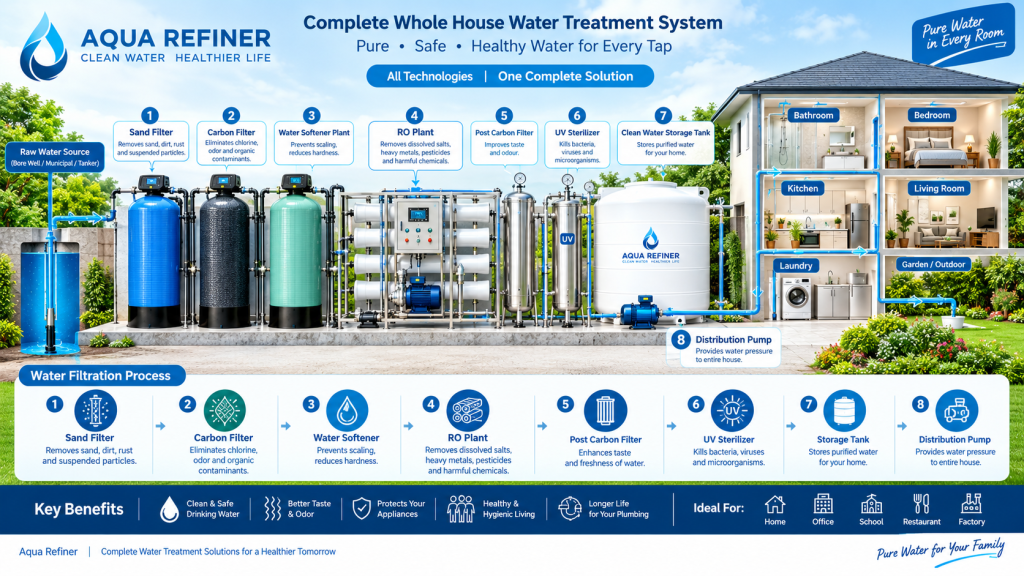
An RO system commonly includes sediment filtration, activated carbon filtration, an RO membrane, and additional stages depending on the design.
Best for:
- Drinking water treatment where dissolved salts need to be reduced
- Bore water with elevated TDS
- Homes and offices requiring treated drinking water
- Commercial water purification applications
Advantages:
- Reduces many dissolved salts
- Can reduce selected chemical contaminants when properly designed
- Can improve taste associated with excessive dissolved minerals
- Available in domestic and industrial capacities
Things to consider:
- Produces reject water during operation
- Requires regular filter and membrane maintenance
- Performance depends on feed-water quality and system design
- May require additional disinfection or other treatment
An RO system is often worth considering when testing shows that dissolved contaminants need to be reduced. However, RO is not automatically the best choice for every water source.
2. Ultraviolet (UV) Water Purifier
UV water purification uses ultraviolet light to inactivate susceptible microorganisms.
It does not remove dissolved salts or reduce TDS. Water may also need appropriate prefiltration so suspended particles do not interfere with disinfection.
Best for:
- Water requiring additional microbiological treatment
- Systems where UV is used as a disinfection stage
- Applications with suitable pretreatment and maintenance
UV can complement an RO system, but a UV lamp alone does not solve every water quality problem.
3. Ultrafiltration (UF) Water Filter
Ultrafiltration uses a membrane to remove many suspended particles and microorganisms, depending on the membrane and system design.
Unlike RO, conventional UF generally does not remove dissolved salts.
Best for:
- Water sources with suitable dissolved-solids levels
- Reducing suspended particles and certain microorganisms
- Selected whole-house and point-of-use applications
UF can be useful where dissolved salts do not need to be removed, but the source water must be assessed before choosing it as a drinking-water treatment solution.
4. Activated Carbon Water Filter
Activated carbon helps reduce chlorine, certain organic compounds, and substances responsible for unwanted taste and odour, depending on the carbon type and contact conditions.
Best for:
- Improving taste and odour
- Reducing chlorine in suitable supplies
- Use as part of a multi-stage purification system
Carbon filtration alone does not reliably remove dissolved salts or all disease-causing microorganisms.
5. Sediment Water Filter
Sediment filters remove suspended particles such as sand, rust, and other visible debris, depending on the filter rating.
They are often used as a first filtration stage to protect downstream equipment.
A sediment filter is useful for particle removal, but it is not sufficient on its own to make microbiologically or chemically contaminated water safe to drink.
Best Water Filter in Pakistan: Which One Should You Choose?
There is no single water filter that is best for every household. Your choice should depend on the water test results, daily consumption, installation requirements, and maintenance budget.
| Water treatment requirement | Technology to consider |
|---|---|
| Reducing excessive dissolved salts | RO |
| Reducing chlorine taste and odour | Activated carbon |
| Removing suspended particles | Sediment filtration |
| Reducing certain microorganisms | Suitable UV or membrane treatment |
| Treating several water quality problems | A properly designed combination system |
| Treating water for a factory or commercial facility | Customized water treatment plant |
For example, a household with elevated dissolved salts may need RO, while a water source with low dissolved salts but a microbiological concern may require a different treatment approach.
A laboratory test is the best starting point for selecting an appropriate system.
Water Filter Price in Pakistan 2026
Water filter prices in Pakistan vary by technology, capacity, component quality, installation, and after-sales service.
The following are broad, indicative budgeting ranges for initial comparison, not verified live market prices or Aqua Refiner quotations.
| Water filter type | Approximate budget (PKR) |
|---|---|
| Basic tap or sediment filter | 9500–12500 |
| Basic domestic RO system | 33500–39500 |
| More advanced domestic RO system | 45,000–65000 |
| Whole House Filtration | 95,000–245000 |
| Commercial RO system | 450,000+ |
| Industrial RO plant | Project-specific quotation |
Actual prices can fall outside these ranges. Commercial and industrial systems vary particularly widely because their capacity, pretreatment, pumps, membranes, automation, and installation requirements differ.
Before purchasing, ask the supplier for an itemized quotation showing what is included and what will cost extra.
What Affects Water Filter Prices?
Filtration technology: RO, UV, UF, and carbon filtration have different components and capabilities.
Water quality: High hardness, excessive dissolved salts, iron, or other contaminants may require additional treatment stages.
Capacity: A system designed for a single household has different requirements from a system serving a hotel or factory.
Component quality: Membrane specifications, pumps, filter housings, valves, and monitoring equipment influence performance and cost.
Installation: Plumbing modifications, storage tanks, electrical work, and transportation can add to the total project budget.
Maintenance: Replacement filters, membranes, cleaning chemicals, and service visits contribute to long-term ownership costs.
How to Choose the Best Water Filter for Your Home
Step 1: Identify Your Water Source
Determine whether your water comes from a bore well, municipal supply, tanker, or another source.
Water from the same general source can vary between locations. Do not assume that a neighbour’s filtration system will necessarily suit your home.
Step 2: Test Your Water Quality
Ask a qualified laboratory to test the parameters relevant to your water source.
Depending on the circumstances, testing may include:
- TDS and electrical conductivity
- pH and turbidity
- Hardness
- Microbiological indicators, including E. coli
- Relevant chemical contaminants, such as arsenic or nitrate
A TDS meter is useful for measuring an approximate level of dissolved solids, but it cannot identify individual contaminants or confirm that water is safe to drink.
PCRWR provides information about its water quality laboratory capabilities at https://www.pcrwr.gov.pk/water-quality/.
Step 3: Calculate Your Daily Water Requirement
Estimate how much drinking and cooking water your household uses each day.
For a business, calculate the required output in litres per hour or litres per day. Include peak demand and future expansion when selecting equipment.
Step 4: Compare Complete Specifications
Do not compare systems only by the number of filtration stages. A higher stage count does not automatically mean better purification.
Check the membrane specifications, treatment performance, replacement-filter availability, reject-water requirements, warranty, and installation conditions.
Step 5: Consider After-Sales Service
A reliable maintenance arrangement is important for any filtration system.
Before purchasing, ask how frequently filters need replacement, whether spare parts are readily available, what the warranty covers, and how service requests are handled.
Domestic Water Filters vs Commercial and Industrial RO Plants
Domestic filters and industrial RO plants serve different purposes.
A domestic water purifier is generally designed for drinking and cooking water in a household. A commercial system may supply a restaurant, office, school, or hotel, while an industrial plant may serve manufacturing processes or large-scale water treatment operations.
Industrial projects may require pretreatment, high-pressure pumps, multiple membrane vessels, control panels, storage tanks, and specialized post-treatment.
If you operate a factory, hotel, hospital, school, or water supply business, select the system based on the required treated-water quality and production capacity rather than choosing a household filter.
Aqua Refiner can be contacted to discuss the requirements of a commercial or industrial water treatment project.
How to Maintain Your Water Filter
Proper maintenance helps keep a filtration system operating as intended.
- Replace sediment and carbon cartridges according to the manufacturer’s instructions and actual operating conditions.
- Inspect the RO membrane and assess its performance when production declines or water quality changes.
- Clean and sanitize storage tanks and associated components as recommended.
- Maintain UV lamps and sleeves according to the manufacturer’s schedule, where UV is installed.
- Check for leaks, unusual noises, reduced water flow, and changes in taste or odour.
- Arrange periodic water quality testing where safety is a concern.
Do not rely exclusively on taste, smell, or a low TDS reading to judge drinking-water safety.
Why Choose Aqua Refiner?
Aqua Refiner provides water treatment solutions for customers who need help identifying an appropriate filtration system for their application.
Whether you are planning a home drinking-water system or exploring commercial and industrial RO equipment, the first step is to understand your water quality and expected consumption.
When contacting Aqua Refiner, share:
- Your city and installation location
- Your water source
- Your water test report, if available
- Your daily water requirement
- Whether the system is for home, office, commercial, or industrial use
- Your preferred installation timeline
This information helps establish the scope of your requirement and makes it easier to discuss suitable equipment and obtain a relevant quotation.
Visit the official website: https://aquarefiner.com/
Frequently Asked Questions
Which is the best water filter in Pakistan in 2026?
The best water filter depends on the quality of your water and the contaminants that need treatment. RO can be suitable when dissolved salts must be reduced, while UV, UF, carbon, and sediment filtration address different requirements. Test your water before choosing a system.
Is RO water better than UV water?
RO and UV perform different functions. RO reduces many dissolved substances, while UV inactivates susceptible microorganisms. Depending on the water source, both technologies may be needed as part of a properly designed treatment system.
Does a water filter remove TDS?
Not every filter reduces TDS. Conventional sediment, carbon, and UF filters generally do not significantly reduce dissolved salts. RO is specifically designed to reduce many dissolved substances.
How much does a water filter cost in Pakistan?
Prices depend on the type of filter, capacity, component specifications, installation, and maintenance requirements. Basic domestic systems may cost tens of thousands of rupees, while larger commercial and industrial systems can cost substantially more.
How often should a water filter be changed?
Replacement intervals depend on the filter type, water quality, consumption, and manufacturer’s specifications. Follow the maintenance schedule and monitor system performance rather than relying on a fixed interval for every installation.
Can I use an RO filter for bore water?
Yes, an RO system may be suitable for bore water when its design matches the water quality. Test for relevant contaminants and assess hardness, scaling, and pretreatment requirements before installation.
Does a low TDS reading mean water is safe to drink?
No. TDS measures dissolved solids, not every contaminant. Water can have a low TDS reading and still contain harmful microorganisms or specific chemical contaminants. Appropriate laboratory testing is important.
How can I get a water filtration quotation from Aqua Refiner?
Visit https://aquarefiner.com/ and contact Aqua Refiner with your city, water source, intended use, daily consumption, and any available water analysis report. These details help determine which system should be considered.
Contact Aqua Refiner for Water Filtration Solutions
Looking for a suitable water filter for your home or business?
Do not choose a system based on price or stage count alone. Start with water testing, identify your treatment requirements, and compare the full equipment specifications.
Contact Aqua Refiner to discuss your water filtration needs and request a quotation.
Website: https://aquarefiner.com/